
CFD · Verified · mesh-independence study (GCI)
Mesh independence study for your duct or pipe CFD.
We solve your case on three meshes, calculate the grid convergence index on the pressure drop and write one line in the report: does the mesh still change the answer, and by how much.
from $99 (no GST) · results within 24 hours · internal flow up to about 6 M cells
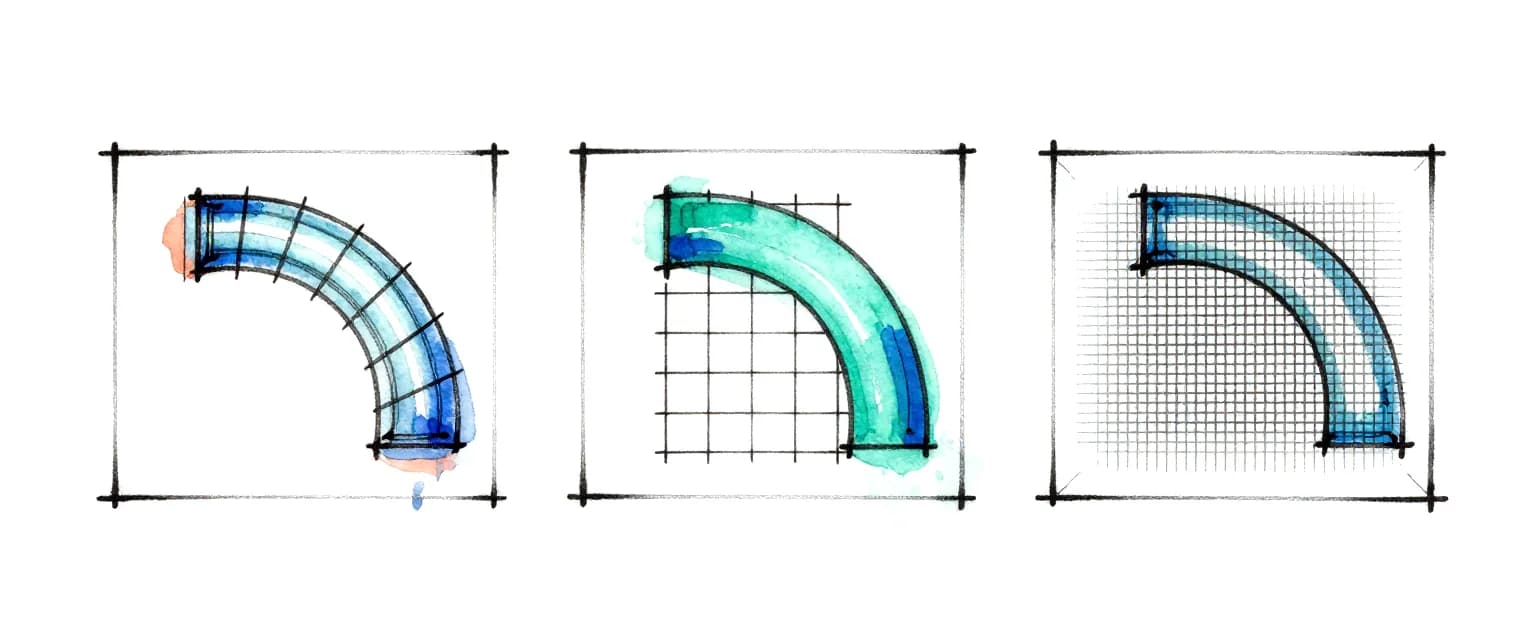
The idea
What a mesh independence study is.
Also called a grid independence study or a mesh convergence study. One case, three meshes, one question: is the mesh still part of the answer?
A CFD solver works on cells. Cells that are too big smear out the detail of the flow, and the pressure drop you read carries some error from the mesh itself. Make the cells smaller and the answer moves; make them smaller again and, on a well-behaved case, it moves less.
A mesh independence study measures that movement. When the change between the two finest meshes is small and shrinking the way theory says it should, the mesh is no longer what decides your number, and the grid convergence index (GCI) tells you how big a band to put around it.
- 1 · Three meshes
- Coarse, medium (your quoted mesh) and fine, with a refinement ratio r = 1.3 between neighbours. Same geometry, same boundary conditions, same wall-layer rule.
- 2 · Solve each one
- Every mesh is run to its residual targets. A mesh whose pressure drop has stopped moving (≤ 0.2 % over its last 200 iterations) counts as settled, and the report says so.
- 3 · Compare the answers
- Static pressure drop from inlet to outlet on each mesh. The changes between them tell us whether the answer converges as the cells get smaller, and how fast.
- 4 · Calculate the GCI
- Grid convergence index on the fine mesh, per Celik et al. (2008), with a safety factor Fs = 1.25 and the apparent order limited to the formal order, 2.
The method
How we do the GCI calculation.
The procedure published by Celik et al. (2008) in the Journal of Fluids Engineering, the one most journals ask for, applied to the static pressure drop.
Never narrower than the solver
When a mesh did not stop on its residual targets, the band is at least half the swing of its pressure drop over the last 200 iterations. If the meshes differ by less than that swing, the swing is the band and the verdict says so.
One line in the report
“Mesh-independent: static pressure drop = X Pa ± Y % (GCI, fine mesh)”, or a plain statement that it was not shown, with all three meshes, their cells and their results in a table, and the plot.
Worked example
Our 90° bend on three meshes.
One of our own validation runs, through the same code a customer job uses: 90° bend, R/D 1.5, air at 4 m/s, D = 50 mm.
| Mesh | Cells | Static ΔP |
|---|---|---|
| Coarse | 0.25 M | 12.247 Pa |
| Medium | 0.54 M | 12.240 Pa |
| Fine | 1.21 M | 12.205 Pa |
The three answers sit within 0.35 % of each other. With the apparent order capped at 2, the GCI on the fine mesh is about 0.5 %.
But the medium and fine meshes never quite reached their residual targets: the separated flow after the bend keeps moving, and their pressure drop still swung by up to 1.7 % over the last 200 iterations. That swing is bigger than the differences between the meshes, so the band in the verdict is half of it, ± 0.85 %, and the verdict is marked indicative.
Verdict in the report
Mesh-independent (indicative): 12.20 Pa ± 0.85 % (fine mesh)
CFD verification and validation
Verified is not the same as validated.
Verification asks whether the equations were solved right. Validation asks whether they were the right equations. A mesh independence study answers the first question only.
Our straight pipe, 72 diameters long, gave 19.94, 20.07, 19.97 Pa on its three meshes: within 0.63 % of each other. Its developed friction factor carried a GCI of ± 0.6 %. Verified, by any measure.
And it was 4.8 % below the Haaland correlation, well outside that band. The gap comes from the turbulence model at this low Reynolds number, not from the mesh, so no amount of mesh refinement would show it. Only a comparison with a correlation or a measurement does.
That is why we keep the two words apart. Verified tells you the mesh error is small. Our validation cases tell you how the model compares with the textbook. You get both, labelled for what they are.
Mesh-independent means the mesh error is small; it does not mean the result matches experiments.
What Verified means
When it is worth it
When a single mesh is not enough.
A thesis or a paper
Reviewers and examiners ask for a grid independence study as a matter of course. You get the three meshes, the numbers and the method in the report.
A number near a limit
When the pressure drop decides a fan or a pump, the band around it matters as much as the number.
Two designs, a small difference
If two fittings differ by 3 %, you need to know the mesh error is well under 3 % before you pick one.
A report for a client
A single line they can read: mesh-independent, the value, and the band, from a stated method.
For a quick sizing number, the single-mesh Quick and Standard packages on CFD for ducts and pipes are enough: every mesh passes our quality check and has wall layers sized for y+ ≈ 1.
CFD package
NewVerified
mesh-independence study (GCI)
from $99
No GST (export of services). Scales with the cells in your mesh.
- Three meshes
- Your case on a coarse, a medium and a fine mesh, refinement ratio 1.3 between them.
- Grid convergence index
- GCI per Celik et al. (2008) with a safety factor of 1.25; answers that oscillate between meshes are judged on 1.25 × half their spread (Stern et al., 2001).
- A verdict in the report
- For example: “Mesh-independent: static pressure drop = 12.20 Pa ± 0.85 % (GCI, fine mesh)”, with all three meshes and their numbers.
- Scope
- Internal flow: pipes, ducts, fittings and manifolds, quoted meshes up to about 6 million cells. Results within 24 hours; not offered as express.
What it proves, and what it does not. Mesh-independent means the mesh error is small; it does not mean the result matches experiments. Pre-processing / mesh validation is charged separately, as for every package.
How to order: start a duct or pipe job on /cfd. After pre-processing / mesh validation, Verified appears on your quote next to Quick and Standard whenever your model qualifies.
Questions.
What is a mesh independence study?
A check that your CFD answer no longer depends on the mesh. The same case is solved on at least three meshes of increasing fineness; if the result of interest, here the pressure drop, stops changing in a consistent way as the cells get smaller, the mesh is no longer a significant source of error. The grid convergence index (GCI) puts a number on the error that is left.
Is a grid independence study the same as a mesh convergence study?
Yes. Mesh independence study, grid independence study, mesh convergence study and grid convergence study are names for the same check. 'Grid' is the older word for the mesh.
What is the grid convergence index (GCI)?
A standard way, from Roache and set out step by step by Celik et al. (2008), to report the discretisation error of a CFD result as a percentage band. From three meshes it estimates how fast the answer converges (the apparent order), then scales the change between the two finest meshes by a safety factor of 1.25. We report it on the fine mesh: for example, 'Mesh-independent: static pressure drop = 12.20 Pa ± 0.85 % (GCI, fine mesh)'.
How many meshes does a GCI calculation need?
Three. Two meshes give a change but not a rate, so you cannot tell whether the answer is converging. We use three with a refinement ratio of 1.3 between them, which is the minimum Celik et al. recommend.
Does mesh-independent mean the CFD result is right?
No. Mesh-independent means the mesh error is small; it does not mean the result matches experiments. A mesh independence study is verification: it checks that the equations were solved accurately on your geometry. Whether those equations, the turbulence model above all, describe the real flow is validation, which needs a comparison with measurements or a trusted correlation. On our own straight pipe the result was mesh-independent within 0.63 % and still 4.8 % below the Haaland correlation.
What does a mesh independence study cost?
From $99, no GST (export of services). The price scales with the cells in your mesh and is on your quote, next to the single-mesh packages. Pre-processing / mesh validation is charged separately, as for every package. You pay for the iterations run on the meshes that were solved, never more than the quote; a mesh that fails on our side is not charged.
How long does it take?
Results within 24 hours of payment. The study is not offered as express: three meshes, the finest about 2.2 times your quoted mesh, need the time.
Which models qualify?
Internal flow: pipes, ducts, bends, reducers, fittings and manifolds, air or water, steady and isothermal, with a quoted mesh up to about 6 million cells. If your model does not qualify, the quote says why and still offers the single-mesh packages.
What if the meshes do not agree?
The report says so in one line, with all three results, so you know the mesh is still part of the answer. Answers that go up and down between meshes are judged on 1.25 times half their spread (Stern et al., 2001); and the band we report is never narrower than the solver's own swing on a mesh whose result was still moving.