
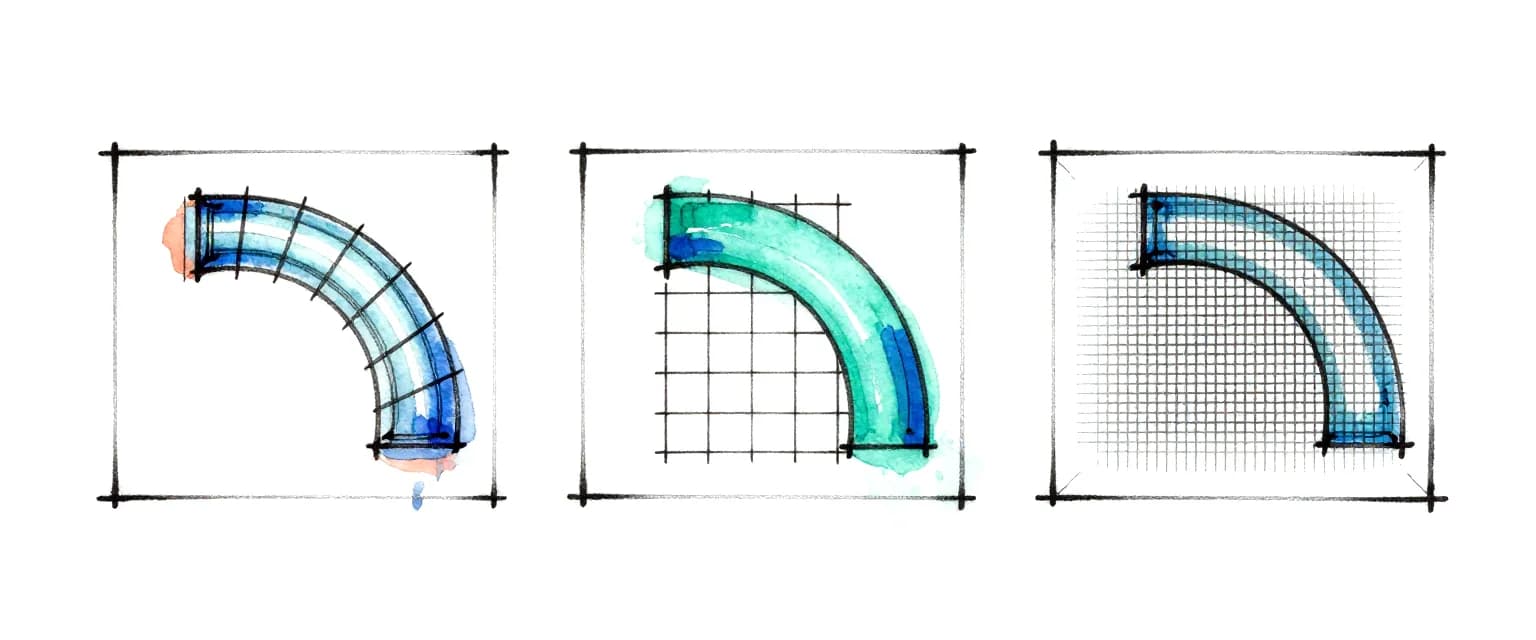
Verification asks whether a CFD model's equations were solved accurately; validation asks whether those equations describe the real flow. A mesh-independence study, reported with the grid convergence index (GCI), is verification: it shows that the error from the mesh is small. It cannot show that the turbulence model, the boundary conditions or the physics are right. That takes a comparison with measurements or a trusted correlation, and a good CFD report keeps the two apart.
Two questions
Solving the equations right, and solving the right equations
Every CFD result has two kinds of error. Numerical error comes from turning smooth equations into millions of small cells and iterating until they balance: cells too coarse, iterations stopped too soon. Modelling error comes from the equations themselves: a turbulence model that is an approximation, an inlet profile that is a guess, a wall roughness nobody measured.
| Verification | Validation | |
|---|---|---|
| The question | Were the equations solved accurately? | Do the equations describe the real flow? |
| What it measures | Numerical error: mesh, iterations, round-off | Modelling error: turbulence model, physics, inputs |
| How it is checked | Residuals, mesh independence (GCI) | Measurements, trusted correlations, benchmarks |
| What it needs | Only the model, run more than once | Data from outside the model |
The two are easy to blur, because both end with a percentage. They answer different questions, and a small number on one says nothing about the other.
Verification
What a mesh-independence study does
Solve the same case on three meshes, each finer than the last by a fixed ratio (we use 1.3 in each direction). If the result converges as the cells shrink, the change between the two finest meshes, scaled by how fast the result is converging and by a safety factor, is the grid convergence index. Celik et al. (2008) set the procedure out step by step, and it is what most journals ask for.
The GCI on the fine mesh
r    ≈ 1.3, mesh to mesh
p    apparent order, capped at 2
eₐ   |φ₁ − φ₂| / φ₁
GCI  1.25 · eₐ / (rᵖ − 1)
Here φ₁ is the result on the fine mesh and φ₂ on the medium one; the apparent order p comes from all three results.
When the three results go up and down instead of converging in one direction, the GCI formula breaks. A common fallback (Stern et al., 2001) is to take 1.25 times half the spread of the three results as the band.
Worked example
A 90° bend on three meshes
Our own test: air at 4 m/s through a 50 mm bend with R/D 1.5, solved with OpenFOAM.
| Mesh | Cells | ΔP |
|---|---|---|
| Coarse | 0.25 M | 12.247 Pa |
| Medium | 0.54 M | 12.240 Pa |
| Fine | 1.21 M | 12.205 Pa |
The refinement ratio from medium to fine is (1.21 / 0.54)^⅓ ≈ 1.31. The relative change between those two meshes is 0.035 / 12.205 ≈ 0.29 %. With the order capped at 2, rᵖ − 1 ≈ 0.71, and the GCI is 1.25 × 0.29 % / 0.71 ≈ 0.5 %.

There is a catch, and it is the useful part. The medium and fine runs never quite reached their residual targets: the separated flow downstream of the bend kept moving, and their pressure drop still swung by up to 1.7 % over the last 200 iterations. That swing is larger than the differences between the meshes, so a 0.5 % band would claim more than the runs can support. We report half the swing instead.
the band we report: 12.20 Pa ± 0.85 % on the fine mesh (indicative)
Validation
What it doesn't prove
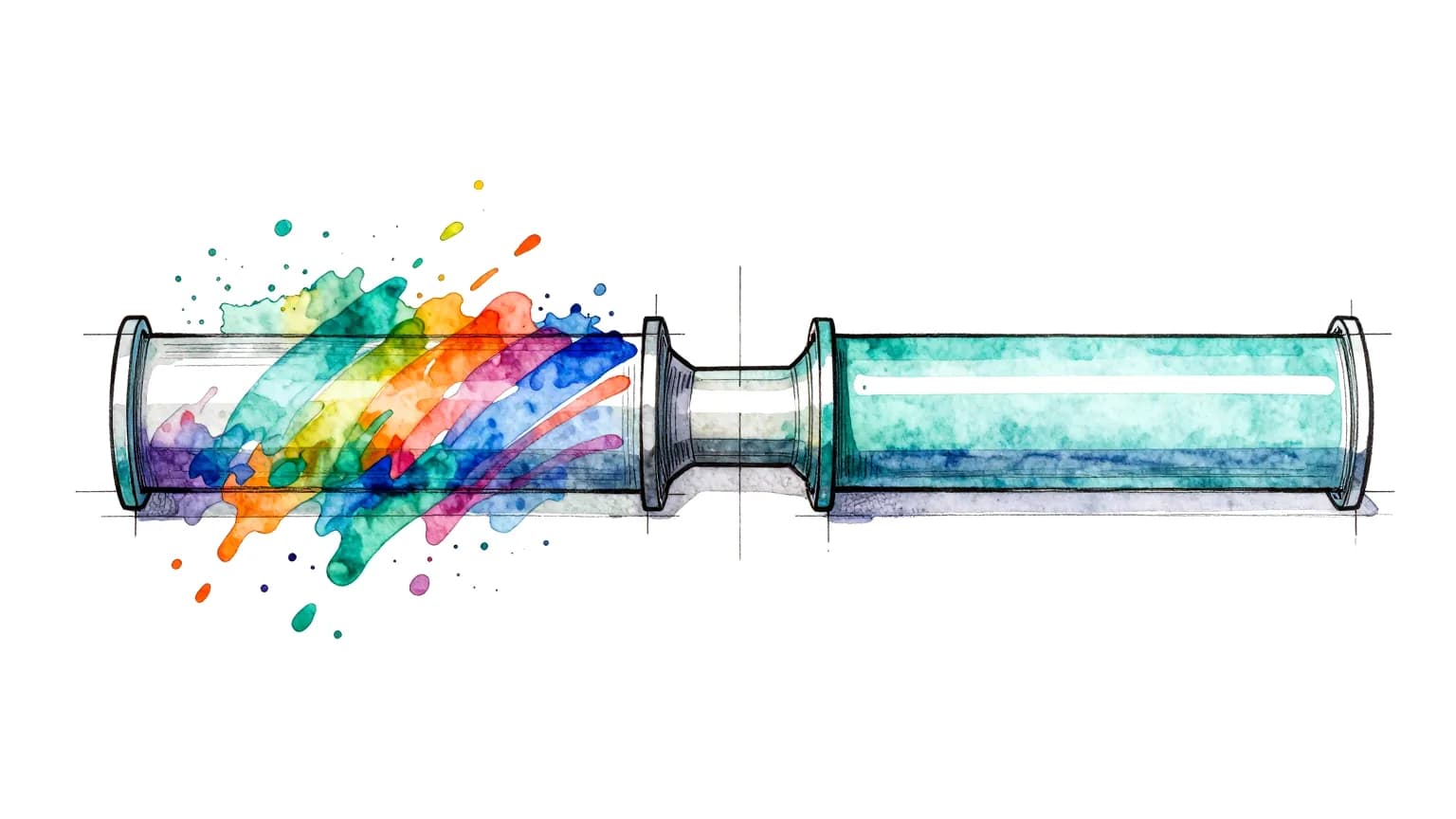
Our second test was a straight pipe, 72 diameters long, at a Reynolds number of about 13,300. Its three meshes gave 19.94, 20.07 and 19.97 Pa, within 0.63 % of each other. The developed friction factor carried a GCI of ± 0.6 %. As verification goes, that is a clean result.
Then we compared it with the Haaland correlation: 4.8 % low, far outside the ± 0.6 % band.
Our straight-pipe validation run, 16 Oct 2026
Refining the mesh would never have found that gap, because the mesh did not cause it. It comes from the turbulence model at this fairly low Reynolds number. Only a comparison with something outside the model, a correlation or a measurement, shows it. That is the whole difference between the two words in one example.
In practice
What to ask of a CFD report
- Converged residuals, or a clear statement that the run was stopped early and why.
- Wall layers fine enough for the wall model used (y+ ≈ 1 for a resolved boundary layer).
- A mesh-independence result with its band, if the decision depends on a few per cent.
- A validation case for the same kind of flow, against a correlation or measurements, with the gap stated.
- Each of these labelled for what it is: a verified number is not called validated.
Coreframe sells the mesh-independence study as its own package, called Verified: your duct or pipe case on three meshes, the GCI and a one-line verdict in the report. See how our mesh independence study works, or start with CFD for ducts and pipes.
Questions
What is the difference between verification and validation in CFD?
Verification checks that the equations were solved accurately: converged residuals and a mesh fine enough that refining it no longer changes the answer. Validation checks that the equations describe the real flow, by comparing with measurements or trusted correlations.
Does a mesh independence study validate a CFD model?
No. It is verification. It shows the error from the mesh is small; it does not show the turbulence model or the boundary conditions are right. Mesh-independent means the mesh error is small; it does not mean the result matches experiments.
How do you calculate the grid convergence index?
Solve the case on three meshes with a fixed refinement ratio r. From the three results, find the apparent order of convergence p. The GCI on the fine mesh is 1.25 times the relative change between the two finest meshes, divided by r to the power p minus 1 (Celik et al., 2008).
What if the three meshes give results that go up and down?
That is oscillatory convergence, and the standard GCI formula does not apply. A common practice (Stern et al., 2001) is to report 1.25 times half the spread of the three results as the band.
Try it on your own project
Open your heaviest scene on an RTX 5080.
New accounts: your first top-up of ₹1,000 buys 8 hours on an RTX 5080, to use within 30 days. Sign up with an email and a WhatsApp code, no ID documents. International cards work.