
CFD · Rooms and HVAC airflow · Live
Room airflow CFD for HVAC designers: comfort, ADPI and draught
Describe one room, its supply diffusers, returns and heat loads, and Coreframe runs a steady CFD of the air in it. You get the mean air speed, PMV/PPD and ADPI, temperature and air-speed maps and a PDF report within 24 hours of accepting the quote. Pre-processing / mesh check is ₹599 incl. GST in India, $15 outside India (no GST); the run price is on your quote.
By the Coreframe Cloud team · Published · Updated
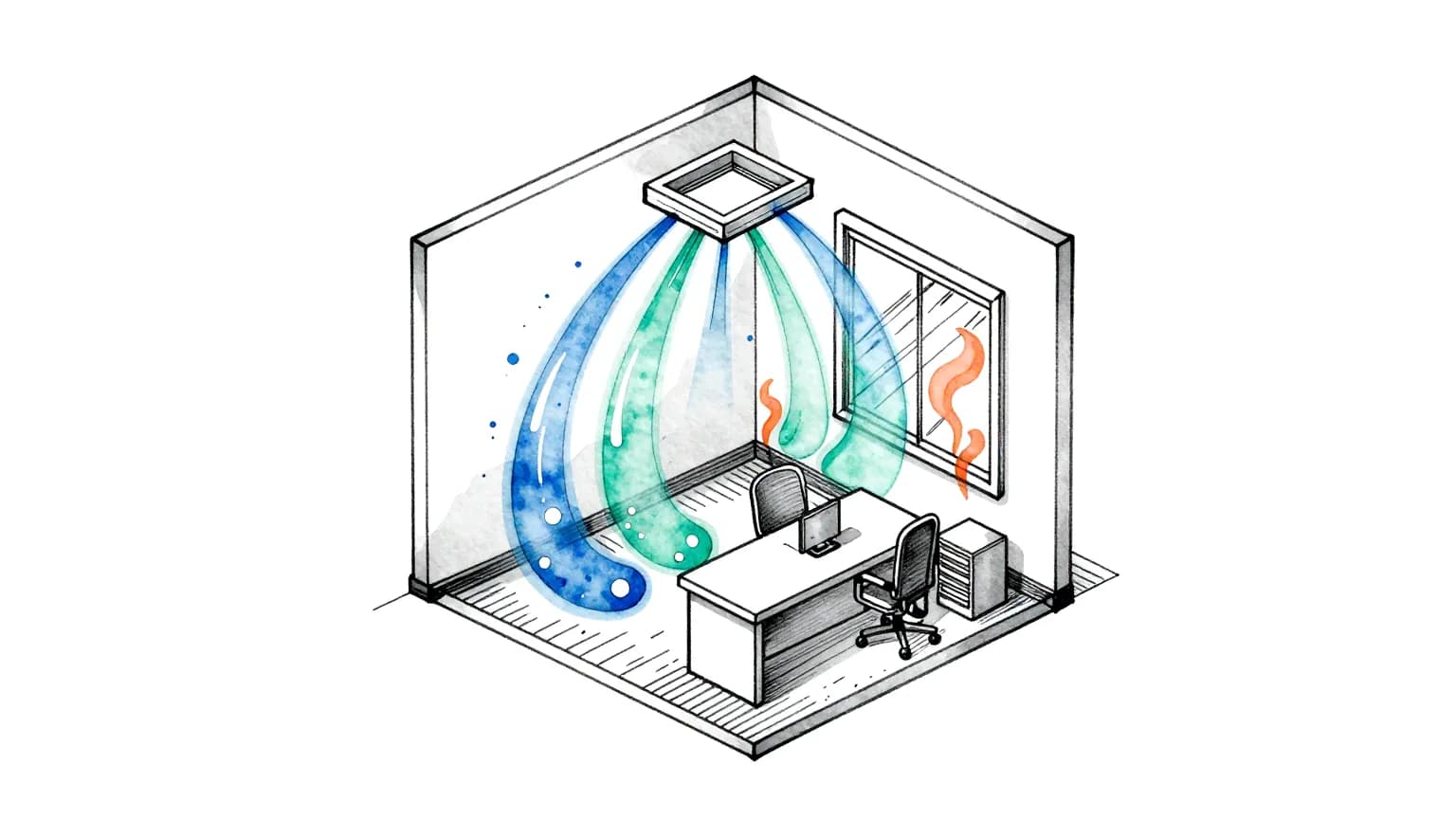
What you enter
A room described on a form, not drawn.
No CAD file. The numbers you already have from the design: the room, the air terminals and the loads.
- The room
- One box-shaped room: length and width from 1 to 100 m, height from 2 to 20 m.
- Supply diffusers
- Up to 12, on the ceiling, floor or any wall: position, size, airflow (m³/h, l/s, CFM or face velocity) and supply air temperature.
- Returns and exhausts
- Up to 12, where the air leaves the room. At least one is needed.
- Heat loads
- People (count and watts each), equipment and lighting, in watts.
- Comfort inputs
- Clothing (clo), activity (met) and relative humidity, for PMV and PPD.
- Mesh
- Draft (a medium mesh) for early design comparisons, or Fine for final numbers. The quote and the report say which was used.
What you get
The comfort numbers, and the maps behind them.
Averages answer “is the room comfortable”. The maps answer “where is it not, and why”.
- Room averages
- Mean air speed and air temperature in the occupied zone, PMV and PPD (ISO 7730) and ADPI (ASHRAE 113).
- Maps
- Temperature and air-speed maps through the room, so you can see where the jet lands and where the air is still.
- A PDF report
- The inputs, the mesh used, the convergence of the run, the maps and the averages, with the validation statement.
Worked example
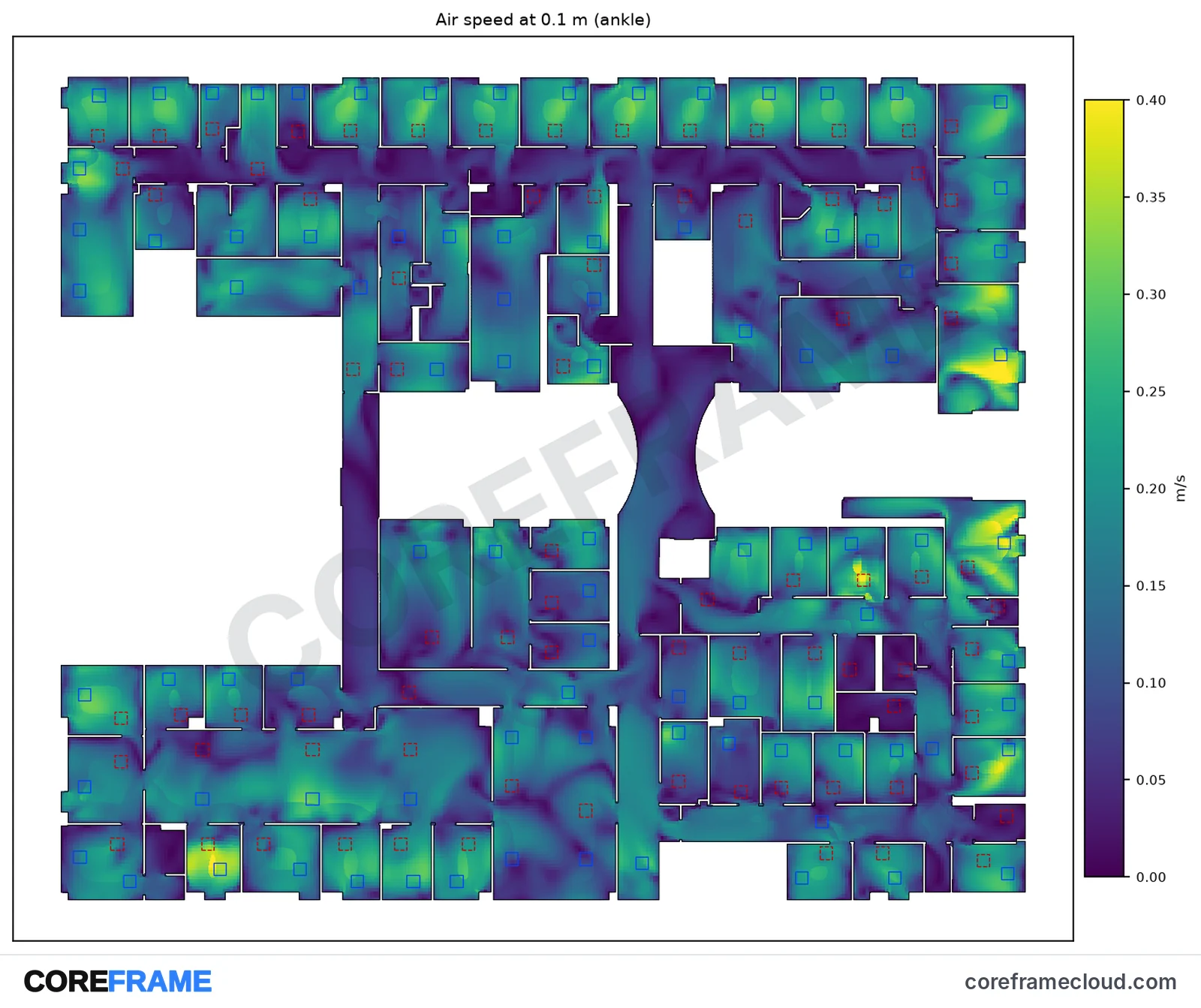
A clinic floor: comfortable at the head, draughty at the feet.
On a real clinic floor with 90 ceiling diffusers at design airflow, the occupied rooms averaged 23.0 °C and the floor reached an ADPI of 93 %, but 15 % of the floor had air faster than 0.25 m/s at ankle height. In the small treatment rooms the ceiling jet reaches the wall, drops and runs back across the floor. It is an indicative, whole-floor first pass, and the case study says what that means.
Reading the numbers
What ADPI tells you, and what it doesn't.
One number for a whole room is useful and easy to over-read.
ADPI, the air diffusion performance index of ASHRAE Standard 113, is the share of points in the occupied zone where the air is neither draughty nor stuffy: the effective draft temperature between −1.7 and +1.1 K, and the air speed under 0.35 m/s. Above 80 % is usually read as good mixing.
It was developed for mixing ventilation in cooling, with ceiling or high sidewall diffusers. It does not judge displacement or radiant systems, the temperature difference between head and ankles, or a cold window. A room can score well on ADPI and still have a draughty corner, which is why the maps and PMV/PPD come with it.
ADPI is a mixing-ventilation score: read it next to the maps, not instead of them.
How to read ADPI
How it works
Four steps, from your account.
- 1
Describe the room
On /cfd, choose Rooms / HVAC and fill in the room, the diffusers, the returns and the loads. No geometry file.
- 2
We check it
Anything we cannot set up is rejected at once, free, with what to change.
- 3
Pre-processing / mesh check
Paid from your Coreframe wallet. We mesh the room and email a mesh report and a quote for the run.
- 4
Accept and get the report
Pay the quote from your wallet; results within 24 hours of payment.
Accuracy and limits
What it has been checked against.
Validated against three published benchmark rooms. Air-flow pattern and air speeds meet the published acceptance criteria. Temperatures in the occupied zone agree with measurements to within about 0.3 K, but did not meet the strict ±5 % benchmark criterion in the heated-floor case. Air temperatures within a few centimetres of heated or cooled surfaces are less reliable.
- One box-shaped room per job, steady state.
- Results are design guidance, not certification.
- Very large models (over 5 million cells): ₹1,499 incl. GST, or $39 outside India, for pre-processing.
Questions.
What does room airflow CFD tell an HVAC designer?
Where the supply air goes in the room, how fast it is moving in the occupied zone, the temperatures people sit in, and the comfort indices: PMV and PPD (ISO 7730) and ADPI (ASHRAE 113). You get room averages (mean air speed, PMV/PPD, ADPI) and temperature and air-speed maps in a PDF report.
Do I need a 3D model or a CFD licence?
No. You describe one box-shaped room on a form: its size, the supply diffusers and returns on its walls or ceiling, and the heat loads. The solver runs on our side.
What does it cost?
Pre-processing / mesh check is ₹599 incl. GST in India, $15 outside India (no GST) for most models, paid from your Coreframe wallet. The run is priced on your quote, after the mesh, and you pay for it only if you accept.
How accurate is it?
Validated against three published benchmark rooms. Air-flow pattern and air speeds meet the published acceptance criteria. Temperatures in the occupied zone agree with measurements to within about 0.3 K, but did not meet the strict ±5 % benchmark criterion in the heated-floor case. Air temperatures within a few centimetres of heated or cooled surfaces are less reliable.
Can it model a whole floor or a non-rectangular room?
Not as this service. It runs one box-shaped room at a time, steady state. For a whole floor, see our clinic case study, an indicative run on a real building model, and talk to us about your project.
Is ADPI enough to judge comfort?
No. ADPI was developed for mixing ventilation in cooling, typically with ceiling or high sidewall diffusers. It scores air speed and temperature at points in the occupied zone, and it says nothing about displacement or radiant systems, vertical temperature differences or warm and cold surfaces. Read it next to PMV/PPD and the maps.
Related: CFD for ducts and pipes · Clinic floor case study · Mesh independence study (GCI)